Showing posts with label Festival City Symphony. Show all posts

Thursday, November 30, 2023

Updates, Fall 2023

Does anyone else feel like everything has been in crazy crunch mode this fall? More than usual? Because I am honestly getting a bit overwhelmed and not seeing a lot of relief ahead.

My Aunt Lila went into hospice and died last month. Both my uncles had surgery this month. I played a funeral for the mother of a friend. All of those events have left me to ponder a bit about which relationships we tend to and which we don't and why.

My only Halloween update is that Mona made a costume that she wore while handing out candy at the tattoo shop, and it made one child cry! Apparently several small kids were scared, which made her feel both bad and good at the same time.


And there is only one cake to share this birthday season. Quinn wanted to be surprised, and I wasn't going to be around in time to make her cake, so I came up with a concept, bought all the supplies, then turned it over to Mona. Quinn turned 17 on the 17th, so since it was her golden birthday, we wanted the most golden cake possible. My original concept was to make two cakes in the shape of a one and a seven, and just go crazy with the decorations. Mona had a different idea, and it was amazing to behold, but not wildly edible.


The reason I couldn't make Quinn's cake myself this year was that I was in Baltimore to give a joint presentation at the Violin Society of America convention. I teamed up with my friend Robyn Sullivan and we did a talk called "Interpersonal Mistake Management." It essentially boiled down to the fact that luthiers are famously sort of rude in their shops, so I made suggestions about how we can do better when working with customers, and Robyn addressed how luthiers can do better working with one another in a shared space. I didn't think I'd be able to attend in person because I had a scheduling conflict with a rehearsal and a concert, but Robyn was kind enough to do all the airport pick-up and drop-off driving, as well as put me up in her hotel room down the street from the convention.

The whole thing was so much fun! When I think back to my first couple of VSA conventions, and how intimidating I found all of it and how alone I felt, this was a whole different experience. I got to meet--in person!--many people from my Women In Lutherie group whom I've only interacted with online before. There were people excited to meet me! And I was excited to meet them! My book (My Violin Needs Help!) was for sale in the vendor room at the International Violin table, and I got to sign copies. I bought so many good tools (including a small saw that doomed my carry-on bag to checked status when I got back to the airport), and met people from suppliers I buy from. I got fed lunch both days I was there (one was for the annual Women's Luncheon, and one was a lunch for vendors and speakers). I caught up with old friends and made new ones. Not to mention the fun of playing pick up ensembles in the new instrument room. We had enough violists to do the third Brandenburg Concerto with all three viola parts! What a great time. Plus hanging out in a hotel with Robyn was good, because with her it's always the perfect combination of quiet chill time and talk too much time.

Getting ready for our talk as people start filing in!
On top of it all, our talk went really well. People really enjoyed the whole presentation, and thought the topic was long overdue. We've been invited by Strad magazine to turn it into a pair of articles, so if you read luthier trade magazines, keep an eye out for that!

I left not only feeling like I belonged, but that I could have an impact. I'm confident that if I applied to do another talk in the future that they would welcome it. That's not a place I expected to reach. How cool is that?

The Pumpkin Pavilion was fun as usual. Carving day was cold and rainy, so I didn't contribute as much as usual, but I loved going to the park with Mona.

Work in the store has been insanely busy. So much so that I haven't had any time to work on my own instruments at home. I can't rehair bows until midnight and then hope to carve scrolls, so I need to make time somewhere and get back in my home shop. People are waiting for those instruments! Which is wonderful, but a lot of pressure sometimes when my schedule is packed.


At least one thing is getting accomplished that I don't actually have to do myself. We've been having some landscaping work done. Finally. When we bought our house about 13 years ago, we did make a few weak attempts to occasionally plant flowers here and there, but for the most part, we were lucky to simply keep up with getting the lawn mowed. (And about half the time our next door neighbor went and did chunks of it for us when she was done with hers. Because Julie is the best neighbor ever.) We only have so many resources, and it's made sense to fix things inside the house first, which left the outside sadly neglected. But this was the year to do something!

After replacing the deteriorating deck last summer, we needed to finish the back yard with paving stones and grass to pull it all together into a usable space. This summer we did that, and then decided to extend the paving stones around the rest of the house. We had lots of yard that was always just mud and weeds, and now we have clear paths that are a big improvement. We have a new extended retaining wall that I love! Far better than the blocks that were starting to fall into the driveway and sidewalk. The last bit (that should be done in the next week or so) is to have stairs installed on a bit of hill that everyone insists on walking up. No one who parks in front of the house wants to walk down to the corner to use the steps there, they want to make a straight line to the door, and that slope is usually a muddy mess. Steps! Very excited to have steps. And the landscaper promises to come back in the spring and plant things that I shouldn't have to do much with. So all of that has been nice, because even as I'm behind on everything, every once in a while I glance out the window and see work happening and can feel happy there is progress somewhere.

The music for Festival City Symphony has been challenging lately. The last concert was all Russian composers, and that's a lot of notes. There's also been some tricky things to learn for the mandolin orchestra, but it had to wait until I was done with the Russians, and now I'm buckling down on those parts.

The most jarring thing to happen recently is my mom had a fall. (At what age does it change from someone "fell" to someone "had a fall"? Because I know I am now in the "had a fall" demographic, but did that switch when I turned 50? 40? What a weird milestone.) My mom--on her birthday at the end of October no less--fell down her front steps and broke her heel, busted her glasses, and bruised up her face. Not pretty. But damn my mom is tough. She crawled back into the house and found a phone and called a friend. She had to stay a night in the hospital but is home now. I drove out and spent a few days, and tried to troubleshoot how she could manage on her own without being able to put any weight on the bad foot. Her house is all stairs, but on the second floor she's able to get from a guest room to the bathroom, closet, and her work studio using a walker. I set her up with water and snacks so she wouldn't have to venture to the first floor more than once a day to eat. My brother went out next to stay a week and help. She's doing okay, but it's frustrating for her to not be able to do everything she'd like on her own, and it's frustrating for me to be so far away.

Because of my mom's injury, we decided to take Thanksgiving to her, since she couldn't come to us and we certainly didn't want her to be alone. We bought food, made plans, and then I got Covid. It wasn't terrible. I mostly felt too hot and too cold at the same time one night, and really sniffly and tired. I went on Paxlovid right away and it cleared up my symptoms almost immediately, but I didn't test negative in time to join the group road trip. Aden came down from college and stayed a night in her sister's apartment, and my brother and nephew came over and stayed in the teaching studio, which we figured would keep them all a safe distance from me. Then everyone in my house took a Covid test the day of the drive to Detroit. I was the only one who tested positive, so Ian chose to stay home with me, and everyone else went to visit Mom. What a weird holiday, though, not knowing who was going to be where until the last minute!

It was an odd holiday, but nice. On the kids' end, I think it was good for them to do a road trip with their uncle, and spend time with relatives without us there. Aden got to make a whole Thanksgiving meal (with a little help on the side), and by all reports did a great job! My brother got to check in on Mom, but also got see how my kids interact with one another and was impressed with all of them in new ways. I know my mom loved having her son and grandkids around.

Ian's and my quiet turkey day was a throwback to before we had children, because I think it's the first time we've been alone together in our house for a couple of days in a row in over twenty years. Isn't that crazy? There's been a lot going on for a very long time. But with just Quinn living at home now, we're heading toward empty nester status soon, and it does get you looking at your partner and wondering how that will go. The rhythm of a house with kids is very different from one without. Thankfully, Ian and I had a lovely time. We grocery shopped the day before the holiday (since we'd sent all the food out of state), and that could have been awful, but we had a good time. We only picked out stuff the two of us liked, and did wacky things like buy pie instead of making it. Thanksgiving day was low key and nice and I finally tested negative. Cooking that meal is low stress when you only make it for two. We cooked everything early so we could eat it for lunch, and then again hours later for dinner. We ate off good china in front of the TV and watched a bunch of odd numbered Star Trek movies, which were terrible, and it was a blast. We walked the dog, chatted with the bird, and took a nap in the middle of the day. I loved it.

When everyone returned from Detroit, they were able to stay at the house and hang out for a morning of board games and crepes. Aden even decided to ditch her one Monday class and stay an extra night, so we got to curl up on the couch and watch the season finale to Lower Decks twice and just enjoy having her be part of our home again. 

Quinn has her first college tour coming up this weekend. That's almost too much for me to comprehend, so I will share what I think about that later once I've figured it out myself.

Domino is still cute. We've had her a bit over a year now, but it's hard to remember life without her. I love that dog. She's even a good companion on a long car trip. She traveled with me to the cottage in mid-October when I met my friends there for a girls' weekend before I shut the place down for the winter. And she was with me when I had to unexpectedly go help my mom and was good company there, too.
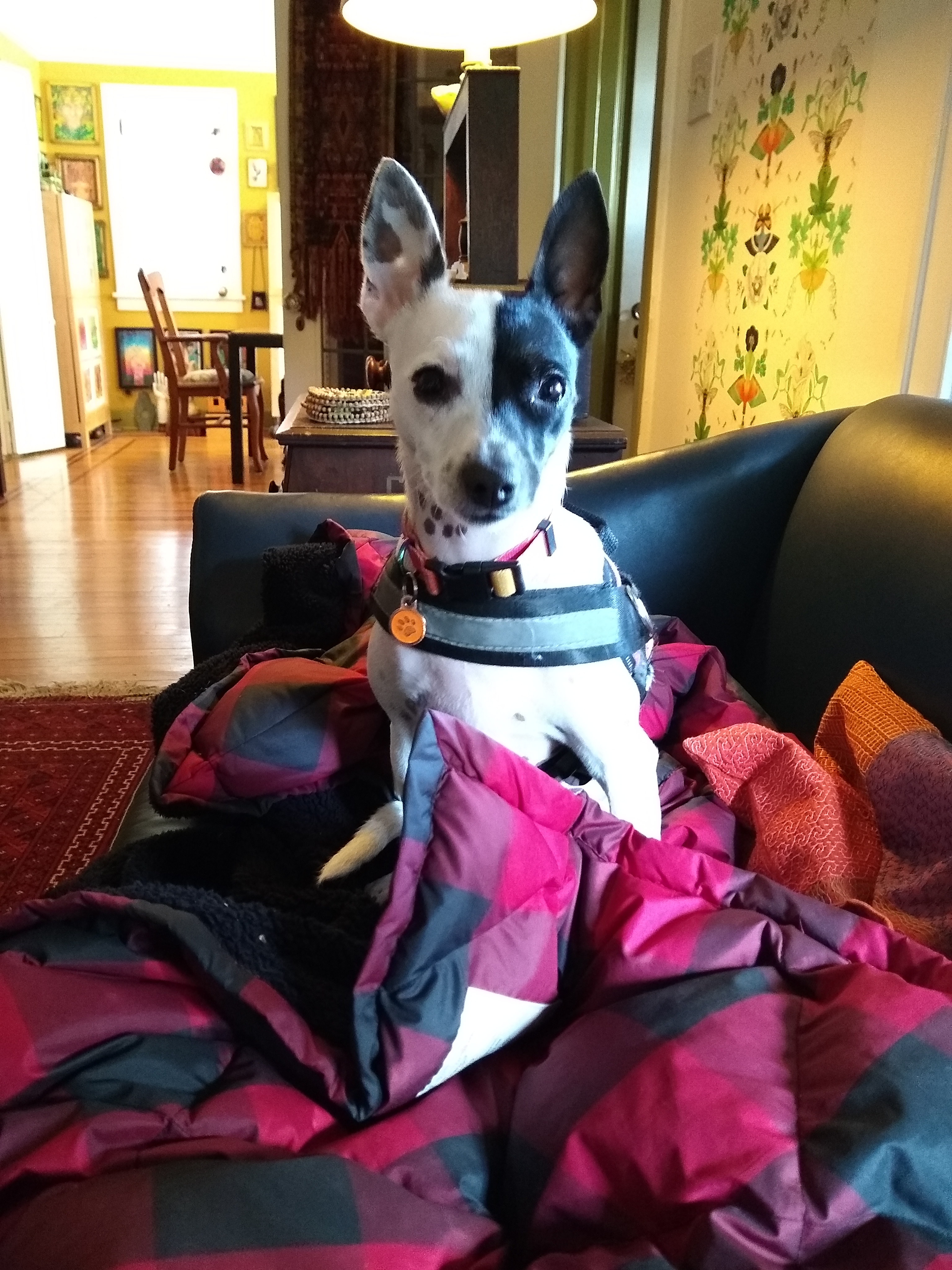
Domino in Detroit

I have four concerts left to play before the year is up, and I need to start thinking about Christmas, but just thinking about thinking about Christmas makes me tired.

But despite feeling like there has been a bit too much happening this fall, I've recently found myself increasingly appreciative of many mundane things. When I drove Quinn to school the other day, the traffic didn't bother me because I was really enjoying the basic act of operating a car. I love our little Nissan Leaf, and now that we have a car that I'm not scared is going to break down any minute, driving is really enjoyable. Any time after being sick, I'm aware of how amazing it is to breathe easily. I like moving without pain. I never used to bother with scarves, but I have one now that makes all the difference in walking in the cold. I enjoy the way the sunlight slants at this time of year.

And I never tire of beautiful leaves.


Friday, December 31, 2021

What Music Can Do

2020 was the year without music. There was nothing. It began with all the normal rehearsals and plans, and then in March everything shut down for the pandemic, we returned our rental parts to the orchestra librarian, and closed our cases. I did, anyway. I was encouraged at first by the idea that I suddenly had time to practice whatever I wanted, but it turned out without anyone to play with or for, practicing was painful.

I wanted to want to play, and much to my surprise, that didn't happen. My viola stayed in the case. My mandola sat in the corner.

It's the only Christmas season I can remember since I first picked up a violin in third grade that I didn't have concerts to play.

2021 decided to make up for that.

Musicians and organizations adapted to Covid. In our orchestra there was a mask requirement and distancing, and nobody shared a stand anymore. Concerts started requiring proof of vaccination for both audience and players.

It's weird playing viola in a mask for reasons I'm still not clear about, but I find myself doing an uncomfortable shift between my progressive lenses and trying to keep both the conductor and my music in my sight line while not fogging up. I've reached a point where I prefer having my stand to myself. I've gotten clever with the copy machine to manage the solo page turns, and I like having the fingerings I use in the part (instead of the outside player's). 

The mandolin orchestra was slower to adopt a mask requirement, but once they did I went back to playing with them as well.

I also joined a newly formed group this year called the Black Diaspora Symphony Orchestra which is open to anyone who wants to promote and perform works by a more inclusive list of composers.

This meant in November and early December, my rehearsal and concert schedule became nearly overwhelming. The BDSO is an amateur group, very new and small, and meets on Sundays. The MMO is an amateur group, the oldest mandolin group in the country and a decent size, and they meet on Mondays. Festival City Symphony is a professional civic group, and they meet on Tuesdays and some Wednesdays. I had to turn down the chance to play the Messiah this season because there were too many conflicts with other groups, and I opted out of a children's concert with FCS to do a different one with the MMO. One week I met with the mandolin orchestra for either concerts or rehearsals six times in five days. That's a lot to manage while also running your own business and caring for a family. I went back to work after most evening rehearsals and wouldn't get to bed until after midnight.

I'm enjoying the holiday break. But what a difference it is to have something to take a break from. My viola staying in its case this week feels like a well earned rest, not the sad surrender to ennui it was last year at this time.

Playing music is work and fun, a challenge and a release, a responsibility and a privilege, and addresses both history and an immediate need. This season I've had the chance to reflect on all of this, along with the many things music can do.

The music this season with FCS so far has been hard. There is no way around having to put in the time to play certain passages correctly, so I spent many hours of work sorting out bowings and fingerings and trying to get them under my fingers reliably. But there is a real satisfaction to performing great music at the highest level you are able. With that orchestra, the goal is to create something as perfectly and beautifully as we can. There is always at least one work from the traditional canon, and we know what those pieces are supposed to be.

When it's going right, performing with that group is glorious and thrilling. It feels like everything my training in college was preparing me to do. When things go off the rails at that level of performance, it's disorienting, and cuts you at the core. We strive for perfection, and hope we do well enough.

The Milwaukee Mandolin Orchestra goals feel different. Of course everyone does their best to play well and everyone wants to sound good--that's simply part of being a musician. But members of amateur groups are there because they love it (by definition, since "amateur" means to love what you do), and that's the prime requirement.

I'm glad when I'm paid for what I do, but there can be something called "over-justification effect" when that happens. I've had stretches where I forget to appreciate how lucky I am to make music because it simply becomes work. Especially if you are playing pieces you don't particularly care for, or in venues or with people you don't enjoy. There are times when music is just a job.

In an amateur group, that's not an issue. You can still get tied into responsibilities that aren't your favorite, but you can always choose to leave. That's different from music where you're under contract to play and perform. Amateur groups are often capable of really beautiful and exciting performances, but the pressure to do that is internally motivated alone. I've played in professional groups where the conductor was at times unkind or downright mean. The director of an amateur group can't risk such behavior, because everyone would walk. The trick is not to push people, but make them want to push themselves.

There is a lot of charm playing with the mandolin orchestra. It can be a big time commitment, but it's fun.

Whether the balance is tipped toward either work or fun, concentrating on music can be incredibly therapeutic. It takes a level of focus that rescues your mind from other thoughts. It's the closest thing I have to meditation, which may seem odd since it's an active state, but it clears away all other things.

A few years ago, I was living through an extended crisis at home that crippled me emotionally, and sometimes physically. I remember opting out of mandolin orchestra several times simply because I was exhausted and didn't think I could spare the energy or the time. But then I decided being out of the house one night was preferable to being in it, and I went to a rehearsal, and it was magic. Like when you have a migraine, and then at some point you realize it's gone and you feel normal again. I got all the way to the end of the mandolin rehearsal before it occurred to me that I hadn't thought of my problems even once the whole night. Music made things better for a little while.

Music improves anything tedious. It makes me smile when our family is on a long drive, and I see my husband tap softly on the wheel in time to whatever music is in his earbuds. It makes cleaning chores more entertaining. I've been playing a lot of Beat Saber recently, and at one point I had to play it without the music and the game was much harder and less enjoyable. Music can rescue my mood if the news gets to be too depressing. I think often about how in a film class we were taught the music in a movie means silence, and silence means something else.

How lucky we are to have music available even when there are no musicians around to play for us. People don't appreciate that enough.

The last concert I played this season was for Black Diaspora. That was a very different kind of experience than anything else I was asked to play this year. FCS is a form of expression and entertainment that is regarded in a serious manner. MMO is at its center more playful. BDSO is organized around a mission, and this first concert was in memory of children who died in the past year. It was more like a prayer than anything else. 

The level of experience for that concert was incredibly varied, from people with decades of experience to recent high school grads. It wasn't going to be a musically perfect concert, but it didn't need to be. What it needed to be was sincere and meaningful, and it accomplished that just fine. BDSO was hard to add into my schedule, but felt the most necessary.

Especially after getting teargassed with several of those same players in Kenosha last year. When I said there was no music to play in 2020, that wasn't quite true. There were no official concerts; there were opportunities to play as part of protests. I think back often about standing in front of the Kenosha courthouse on the second night of demonstrations, and how everything was peaceful until the police decided to come at everyone in riot gear. I'm still amazed how disproportionate the response was to what was happening. And I take pride in trying to stand up for what I think is important using my viola as my voice.

The somber setting in the church (where no one was supposed to applaud between numbers so as not to disrupt the contemplation of the audience) was the opposite of that chaotic experience, but connected in important ways. Music can do things nothing else can.

I don't think I will ever forget the night of our dress rehearsal, when we moved up from the basement space where we'd be rehearsing to the main worship space in the church. We were working on the balance for Aase's Death by Grieg, and I was concerned about the intonation, and coordinating certain phrases across the different parts. I was worried it wouldn't be ready. But then a woman associated with the group's mission came up to us to say that she'd lost her son to an overdose, and that our music captured her thoughts about his dying alone better than any words ever could. What we'd created had brought her to tears. It spoke to her without it being perfect. What we were offering was enough. That was incredibly powerful to be a part of.

The other musical thing I've been thinking about this holiday season is the new Beatles documentary. To say my dad was obsessed with the Beatles doesn't quite capture his level of interest. The first time I really saw him cry was when John Lennon was shot. Their music meant something profound to him, and to many.

My interest in the band doesn't run nearly so deep, but I know my dad would have watched the hell out of that documentary if he were still around. I felt I should watch it in his memory. My daughter agreed to watch it with me while she's home over college break. She really doesn't have any attachment to the Beatles, so I had to explain things as it went along. But even for someone coming in with no knowledge, it's fascinating to watch people in the midst of artistic creation.

For me, the astonishing thing was to be able to watch someone like Paul McCartney experimenting with the chords to something like "Let it Be" and for me to know what it was before he did on the screen. No one in the room at the time had any idea where that would go, no one seemed particularly interested, and there I was on my couch getting goosebumps because I knew all the words. I told Aden you could go nearly anywhere in the world, and you'll find people who can sing that song.

I watched the beginning with Aden, and then we stayed up very late the last night we were in Detroit for Christmas with my mom so she could watch to the end. I'm sure it's not for everyone, but I found it fascinating. I would have so loved to have heard my dad's commentary. Aden and I even watched the Carpool Karaoke clip on YouTube of McCartney touring around his old neighborhood and singing his songs for crowds. It was moving to see how many people in the streets were excited to see him, and wanted him to know his music had been part of their lives. As McCartney was trying to return to his car one man wanted him to know that they played one of his songs at his father's funeral. His music has been the soundtrack to many lives. That makes me tear up.

Music cuts across time greater than anything else I know. Listening to the Beatles feels like having my dad back with me for a moment. Playing Mendelssohn on stage brings the thoughts in his mind back to life for that bit of time. Performing Tin Pan Alley tunes with the mandolin orchestra I'm sure creates the same camaraderie now that it did when our group had all different members a century ago. Playing music to help people heal is as important as its ever been.

I don't know what 2022 will hold in store in terms of getting to perform, but I'm up for whatever I get to be a part of. I don't want to be without music again.

I hope whatever brings you peace and joy abounds in the new year.

Monday, October 25, 2021

Grand

I have the privilege of playing with a wonderful group of musicians here in Milwaukee in an orchestra called Festival City Symphony. Once upon a time they were the Milwaukee Civic Orchestra, but they changed the name to Festival City (which reflects the exciting number of festivals Milwaukee hosts annually) a couple of years before I moved here.

It's an orchestra comprised of people who take music seriously, and probably majored in it, but performance did not become their day job. There are a lot of music teachers and gig musicians and freelancers, but many who do any number of other jobs to pay the bills and still make the time for orchestra. Because if you grew up playing in an orchestra, it's hard to picture life without it.

Many musicians got a taste of life without it during the first year of the pandemic and it felt like missing a limb. Festival City canceled the end of its season in the spring of 2020, but started up again with many protocols in place in the fall. I ventured back into rehearsals and onto the stage earlier this year. It's been a relief and a challenge all at once.

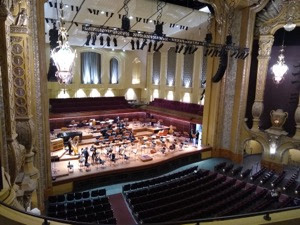
The opening of this season, however, was remarkable. We are in a new exciting space.


Our concerts pre-pandemic were in the Pabst Theater. It's beautiful, and has my favorite chandelier. During the pandemic we shifted to a hall out at the Wilson Center, which was fine. (A bit of a haul out of the city, but fine.) However, for several years the Milwaukee Symphony Orchestra has been renovating an Art Deco movie theater in the heart of downtown called the Grand Warner. It has sat closed the entire time I've lived here, and I only heard stories from people about how beautiful it was inside. The MSO acquired the building and put a lot of effort and money into moving walls to create a real stage, and expanding the building with a modern addition to the side. The grand opening was supposed to be fall of 2020. They only just moved in recently.

One of the benefactors who donated money to the whole enterprise happens to be a former Festival City musician. He loves our orchestra and knows its worth to the community. He managed to carve out a deal that allows us to perform in that gorgeous building as well.

Wow.

Now, I'm a bit sad that the last time I performed in the Pabst, I didn't know it was the last time I was performing on that stage. The plan was always to move on to the new Bradley Symphony Center inside the Warner theater for this season, but with the previous season cut short and then the venue moved, we didn't finish at the Pabst the way we expected to.

However, what an incredible experience to play in a hall that is specifically designed for an orchestra. Not a space that is designed for a variety of events that an orchestra can also use. This new hall is conceived entirely around what a symphony orchestra needs and you feel it at every turn.

First of all, just from an anyone perspective, the whole building is stunningly beautiful. In centuries past, the grandest structures that money could buy in any town were usually places of worship. In modern and more secular times it seems to me that museums and concert halls are the new cathedrals where society places the greatest importance on design and beauty in order to cradle and showcase the achievements of which we are most proud. This new hall is no exception, and is one of those landmarks where you feel a tad smug that people outside of Milwaukee don't know what they're missing. The great things in our city don't tend to be for tourists, since nobody visits Milwaukee without a reason. There's something extra special about stepping inside a beautiful concert hall that is intended for us, the locals. I hope everyone in the city gets a chance to enjoy it and feel inspired there.

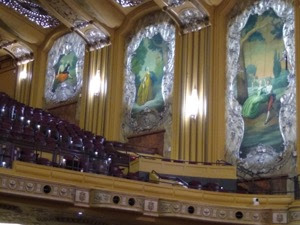
This is the point where I'm going to apologize for not having better pictures. (Go look at the pretty ones in that first link when you have time.) Most of what I had access to was from the stage or behind the scenes, and when I went out in the general areas to explore, I kept hearing staff on their modern walkie-talkies behind me sharing the information that, "The musicians are wandering." I was eventually gently herded backstage, but not before I poked my head onto the balcony to see what things looked like from that direction.

There are restored paintings on the walls of very white people doing very stylized rich people things which are both pretty and kind of funny.

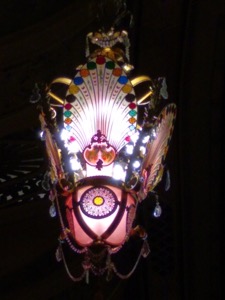
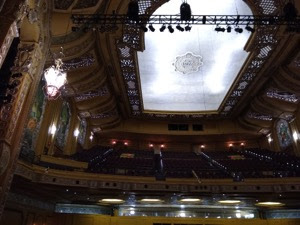
I miss the chandelier from the Pabst, but it makes sense that in a theater originally designed for movies one wouldn't have made a lot of sense. But there is a lovely ceiling nonetheless, and a couple of elaborate light fixtures hanging off to the sides.

And I only got a glimpse of the lobby from above, but it was all just gorgeous.

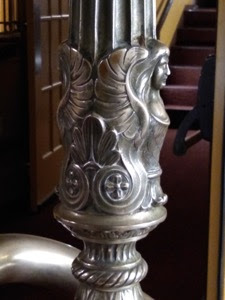
And everywhere you look there are restored details to admire (like this one little piece of a bit of railing at the top of the stairs).

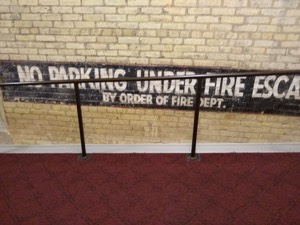
One of the other details I enjoyed was where they left evidence of the original outside walls. I noticed in the alley I walked through next to the building when I was trying to find the stage door, that there were old painted warnings on the brick admonishing people not to park below the fire escapes (which was amusing since there are no fire escapes on any of those walls now). Some of those same warnings are now inside the building! I love that they left that when they expanded beyond those walls.

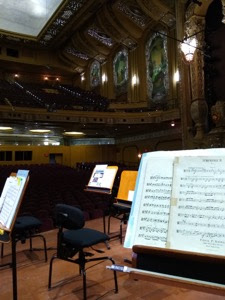
So that's the kind of stuff everyone can get to enjoy. My perspective is generally more like this:


But here is a good place to start pointing out cool musician oriented details! First of all, the stage chairs are fancy. I don't know if they are smart, because we had to get a tutorial at the beginning of the rehearsal mostly to inform us that the two levers under the seat must only be ever pulled up. Apparently if you push down on them (and everything about them suggests you should push down on them) they will break. One lever adjusts the height of the seat, and the other the angle, but I was too scared to touch them and decided I was fine with whatever height and angle was there when I sat down. But they were very comfortable and excellent for orchestral playing,

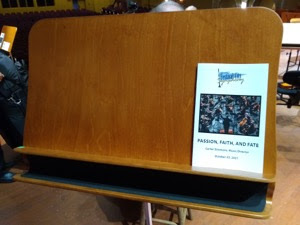
The other thing is the stands. I wasn't sold on the chairs, but I want one of those stands.

It was solid, wide, and smooth (the most common type of stand has inexplicable bumps on it that sometimes interfere with marking a paper part with a pencil), and best of all had a lower shelf lined with a grippy material perfect for setting your bow in. (And considering there's an entire movement of the Tchaikovsky symphony we played that's all pizzicato, that shelf came in handy.)

That shelf is also perfect for pencils, rosin.... I love the shelf.

Only less than optimal thing was the height adjustment required you unscrew something first, but eh. You don't do it that often anyway.

The brass and woodwinds had their own sections on risers. And there are seats behind and on the sides above the orchestra that I assume are for singers.

But it's the stuff offstage that I think I appreciated most.

At the Pabst, the green room was under the stage. It was okay. There were some tables and chairs, a couch or two, inadequate bathroom facilities, a TV that was only on when players wanted to check a Packer game. There were dressing room spaces that some people used to unpack their instruments and store their cases and coats, but most of us found space to balance our things on random beams that were the structural supports behind the adjustable stage walls. There were a few tables on one end, and cellists tended to prop their cases along a wall, but not too close to the hot pipes. It was dark back there, and dirty. It wasn't really where we were supposed to store our things, but it was the most convenient place in terms of proximity to the stage.

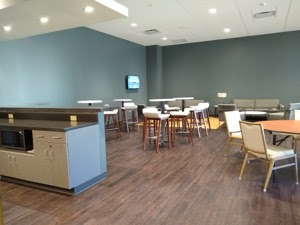
The new building? Well, the green room is across the hall and on the same level and includes monitors of the stage.

Lots of light in this building, and lots of windows. And I noticed signs indicating practice rooms upstairs, so that must be nice. 

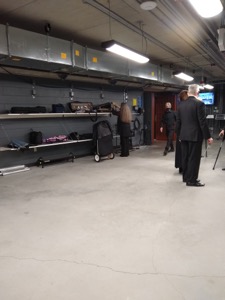
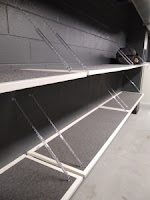
And in the wings around and behind the stage there was so much light and useful storage! Not to mention several mirrors, a couple of large monitors so you could see the stage, and lots of room to move.

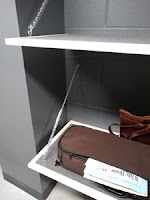
Even the chains on the shelves had little plastic covers on them so you wouldn't snag yourself on anything. It was great to have an actual spot to set my case right off the stage.


There were cubbies for cellos on their side of the stage.

Also? Amazing security. That place was on top of everything (including "wandering musicians"), so I wasn't worried about leaving any of my stuff backstage. 

This concert was also the first event I've attended since the pandemic began that required proof of vaccination (or two negative tests within a few days), and nearly everyone was masked, so I was far more at ease in such a crowded setting than at anything similar in recent memory.

And aside from all the beauty and practical details? The hall sounds incredible. Which is truly the whole point. The sound engineers and acoustics people did an astonishing job. It's almost a little too good, in that you can hear everything on that stage and you become very self aware. I took my necklace off after the sound check, because the clicking sound it made as I put my instrument to my neck seemed like it might carry to the audience. Probably not? But it sure felt possible.

I'm pleased to report the concert itself went well. We played Dvorak's Carnival Overture, Bizet's Orchestral Suite from Carmen, and Tchaikovsky's Symphony Number 4. And I have to say, the sound of the brass reverberating in the hall in the rests following their big opening chords of the symphony was really something. It is a magical place to hear the power of live music.

If you're in the area and want to experience something grand, I highly recommend you get a ticket to whatever is happening there. (And Festival City Symphony concerts are free! Come join us! This season's schedule is here. William Grant Still, Aaron Copeland, Mendelssohn, Schubert... lots to like.)


Sunday, January 10, 2021

Time for Music

I got to play an orchestra rehearsal last week. I get to do it again this week. The weight of what all of this means to me is something I'm still processing, because sometimes you truly don't know how important something is until it's gone.

For most of my life, my schedule has been organized around rehearsals, concert dates, and making time to practice. I've had to delay family Christmas plans to perform at a midnight mass at the basilica. Options for my kids' spring breaks were impacted by if I had a dress rehearsal that week. In college, orchestra was graded entirely by attendance, and if you missed one of the daily rehearsals, you went down one full letter grade. Since moving to Milwaukee, Tuesday nights have been completely blocked off in my mind as rehearsal nights, and before I can commit to anything else on a Tuesday, I have to check my orchestra schedule.

Then the pandemic hit, and in March of 2020 everything came to a halt. Concerts were canceled. Rehearsals stopped.

Intellectually, I knew that continuing to practice was the correct and healthy choice. I tried at first. I pulled out pieces I knew would be fun and interesting to play. There was lots of time suddenly available to hone my skills in a thoughtful way that normally doesn't happen. But....

Creativity takes energy. In the early days of Covid, all my energy was spent elsewhere. Worry, survival, adaptation, grief... All of it saps energy. And knowing what you should do, doesn't always mean you can.

My viola stayed in the case. I wanted to play. Or more aptly put, I wanted to want to play, but the lack of anyone to play with or for killed my motivation in a way that surprised me.

The important exception was in the middle of summer when I was invited on a couple of occasions to perform along with the Black String Triage Ensemble. They perform protest concerts in response to violence against people of color in our city. The group was organized by a former student of mine, and he asked if I wanted to join them to play black spirituals at various locations to draw attention to racial injustice. One of those locations was in front of the courthouse in Kenosha during the second night of the protest marches there.

Music has meaning, and music has power. Enough power that we had to be forced to stop making music in Kenosha with teargas, apparently. But if I only got to play one concert in 2020, I'm glad it was that one. It was a clear reminder of what matters and how music can help.

Playing music with others, for others, draws on the finest elements of what it is to be human. We create something bigger than ourselves, something more beautiful than we could do alone. Something built from small moments of practice piled one upon the other to eventually create something grand and moving when everything aligns properly. It's a strangely momentous thing to come to take for granted, but when most of your life is built around a schedule of rehearsals, and concert dates--to the point that you consider them ordinary--you can forget.

While orchestras across the country and the world shut down for the year, Festival City Symphony found a way to forge ahead. The spread and death toll of Covid in our state made me too nervous to participate in the first two concerts of the season, and I asked not to be included on the roster. That was painful to do, partially because I deeply missed playing, and partially from guilt that so many other musicians were desperate for the same opportunity I was passing up. But after watching the FCS holiday show online, I was encouraged by the number of safety protocols. I agreed to play the first concert in 2021. I fully intended to back out if when I showed up to the first rehearsal it didn't feel safe.

Everyone was masked, including wind and brass players who had to have special masks with an opening to use when they needed to play, and covers over the ends of their instruments. Everyone had their own stand and was set far apart. The stands were tagged with people's names, and no one was allowed to touch anyone else's stand or music. The ventilation in the room was good enough that the air was completely replaced in it three times an hour. All foot traffic in the building had to move counterclockwise to help people maintain distance. We had to present a signed form upon arrival stating we did not have Covid symptoms or had been knowingly exposed recently. They took our temperature before we could proceed into the building. The length of the rehearsal was kept short, and there was no break when people would normally mingle. The concert itself will have no intermission and will finish in under an hour. There will be a cap of 150 audience members, masked, and in assigned seats set apart from other parties, with no seating in the first couple of rows closest to the orchestra. My family will watch with the virtual option.

So as much as you can mitigate risk for an orchestra to play together, I think they've managed it. I'm still nervous, but do not feel unsafe. And I am incredibly grateful to have a reason to open my viola case again.

However, the physical task of playing after so much time caught me off guard. It's work. Actual physical work that you need to train muscles to do. I don't think most people realize that. Simply holding up your arms for hours takes strength. In fact, when I was in college, there were guys in my dorm who thought it was impressive that I could hold my own in an arm wrestling match if I used my left arm. I haven't used those particular muscles in a while, and when I started practicing again I was really sore.

It's also weirdly cumbersome to play with a mask on. I wouldn't have guessed that, but it's somehow harder to see the way you need to, glancing past your instrument to the music and up at the conductor regularly. I'm not sure exactly what about the mask is in the way, it just is, so that will take getting used to as well.

I've been working my way back up to playing for longer stretches, and with a mask on sometimes, so that I'll be prepared for the concert. Plus I had to follow all the advice I give everyone else who comes through my shop, and gave my own viola a checkup and actually rehaired my bow and changed my strings. It made a big difference.

It will be a good show! If you want to watch it, the information is here. We'll be playing Holst's Brook Green Suite, Schubert's Fifth Symphony, and Frank Almond will be the soloist for The Lark Ascending by Vaughan Williams.

It's strange playing in a mask. It's odd not to have a stand partner. But the camaraderie is still there, even at a distance. And making music is magic. At one point last week in my first real rehearsal in almost a year, I became choked up with how beautiful and amazing it all was for people to work together and bring the air to life with history and sound and meaning. I've missed it. More than I realized.


Sunday, January 26, 2014

Someone in the Audience


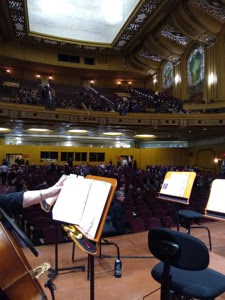
My stage view at sound check
I had a concert this afternoon.  The orchestra I play with is called Festival City Symphony, and we perform in the beautiful Pabst concert hall.  The weather wasn't great so attendance was a bit lower than usual.

But my husband and son were there.

It can't be overstated how nice it is to have people you know in the audience when you are onstage.  I'm just a section viola player, but when there is someone specific to play for it almost feels like getting to play a solo.  I become self-conscious in a good way.  I'm proud of what I get to do, and I love knowing I'm sharing that with someone who matters to me.