Monday, February 28, 2022

Holiday Shift

A couple of weeks ago, I dropped my son off at the mall to see a movie with friends. I arrived a bit early to pick him up afterward, and as I was wandering about and looking at the different shops, I was surprised to see a long line outside of a jewelry store. It was a small shop with Covid protocols in place, which meant a limited number of people inside at a time, but still, why would there be a line at a jewelry store half an hour before closing?

But then I remembered the next day was Valentine's Day. Last minute jewelry purchases suddenly made more sense.

When I mentioned my initial puzzlement about the jewelry store line to my daughter later, she said, "Oh yeah, Valentine's Day. I still kind of think about that as something to be excited for, but I guess that was a long time ago."

The last real time she would have done anything interesting for Valentine's Day would have been in sixth grade, so half a dozen years back. She used to make amazing Valentines for the kids in her class. My favorite was the year of the "pocket mice" which were all little pink and red sculptures made from colored duct tape. All my kids made their own Valentines to hand out at school, which meant when all three kids were in elementary school there was a lot of cutting and pasting going on at our dining room table for over a week every February.

But now Valentine's Day barely registers. We get a lovely box from my mom every year, and that we still look forward to. The box always contains some lovely handmade cards made specially for each of us, shortbread heart cookies, and surprises. This year there was a lot of much appreciated homemade jam.

Aside from my mom's box, there is no Valentine's Day at our house at this point.

In fact, I'm starting to realize how much of a shift all the holidays have taken now that we are transitioning from having a home full of kids, to a home with just adults. 

My oldest is away at college. My middle kid graduated high school early and is doing classes mostly online at a local college. She's home, but is separated from what the rest of the house is doing much of the time. My youngest is in high school, and tends to go along with whatever is happening, rather than make suggestions or instigate anything.

Halloween was the first holiday I noticed slip away back in 2020. The pandemic killed that prematurely. I really enjoyed putting together costumes for my kids. Quinn was interested in dressing up as at least one of various categories of animal over his trick-or-treating years--and I think 2020 he was due to be an amphibian--but no trick-or-treat, no school dance, no costumes. That's done.

Halloween was a big deal for so long! It was several weeks of planning and work and the excitement of the reveal. Now we hand out candy, which is okay, but comparatively dull. Maybe we can become one of those houses that builds something cool? Bay View has several spots that put together amazing displays that people come from all around to see. Going forward, if we want to still experience Halloween as an event, we may have to do something like that. But the era of my kids doing trick-or-treat in costumes is over. If I still want to do Halloween, it will have to be in some other way.

Christmas has shifted in a more subtle manner. The logistics of it haven't changed: We unwrap presents at home in the morning, and then drive to Detroit to have Christmas dinner with my mom. There was a bit of a pause in that in the beginning of the pandemic, but we returned to it. The kids are still allowed to empty their stockings before the "grown-ups" come downstairs. Once everyone is up, we start unwrapping things from under the tree. It's still fun. I usually manage to find things the kids all like. But my kids commented this year that it's not the same as when they were little. The anticipation is different. The excitement is replaced with a level of appreciation that is nice, but not the same.

Fourth of July we started skipping even before the pandemic shut it down. The parade is very different from a child's eye view, and my kids stopped seeing it as something worth the effort of getting up early for. In a normal year, Milwaukee has a lot of fireworks. As my kids got older and we asked if they wanted to go watch the fireworks in the park, or by the lake, they shrugged it off as something they could do later. Fourth of July has become just a lot of noise.

Easter, strangely enough, has stuck around. We used to travel to see relatives for Easter, and hunt eggs in New York, or Ohio, or once at the cottage in Michigan. In 2020, in order to keep all the days from blurring completely together, Ian and I hid more than 80 plastic eggs all over the house. Because we didn't have to worry about making things too hard for small children, we got to be incredibly wicked with our egg hiding, which was fun. But Aden won't be here for Easter this year. I don't know if I can convince the remaining kids to hunt for eggs without her. Maybe? I hope so.

The only holidays I can think of that are improved by my kids getting older are New Year's Eve (simply because staying awake until midnight is no longer a problem) and Thanksgiving. When they were small, my kids were not interested in eating the food (aside from the rolls and pie), and there's not much to Thanksgiving if you don't want to eat. But now they all contribute to the meal and it's really great. Mona's good at mashed potatoes, Aden makes pies, Quinn starts the orange jello days ahead in the hopes it will gel, and they all help with setting the table and making cool place markers and centerpieces. They're also old enough to take pleasure in sitting at the table afterward and partaking in conversation with the visiting relatives, which was once the most boring thing imaginable. And we play games, which I enjoy better now that we don't have to make concessions for their ages.

We're not quite empty nesters, however it's getting easier to imagine. There are certainly still ways we are involved as parents, but the hands-on elements are fading fast. It's strange now to remember my kids once needed me for everything from bathing to getting dressed to crossing the street. Quinn may be here for another few years, but he does his own laundry and can cook for himself, and aside from needing a ride once in a while when the bus doesn't show, he functions independently from us.

We spent years building up all manner of holiday traditions, and most of them are now obsolete. Ian and I will have to start deciding where to put our holiday energy going forward. Life with Ian is fun, so I'm not worried we won't find things to do, but it will be like starting from scratch.

What did we do before we had kids? Hard to remember. But I'm starting to understand all those parents who clamor for grandchildren. I'm not in any hurry to be anyone's grandmother, but I see the appeal. In the meantime, I'm thinking about how we replace all the cute parts of various holidays with things we can be excited about in new ways. (I'm thinking travel....)


Sunday, January 16, 2022

Beat Saber

Have you heard of Beat Saber? There's a lot of Beat Sabering going on in our house lately, so I thought I'd share.

For Quinn's fifteenth birthday a couple of months ago we reserved time for just our family (slightly reduced to four with Aden away at school) at a VR (Virtual Reality) place nearby. I wanted to do something different for his birthday, but it's hard coming up with anything in a pandemic. The VR time was perfect. It's like video games with a headset over your eyes, and a controller in each hand. I was surprised at how immersive it was. We each took turns trying different things: Mona wandered around in something called Half Life, Ian did some sort of space/shooting game, then moved on to mini golf. Quinn and I got introduced to Beat Saber, and were even able to compete against each other for a few rounds.

Beat Saber turned out to be insanely fun, and we ended up getting a VR system for home so we could do it whenever we like. 

The VR system was the family Christmas present this year, which made shopping pretty easy since we all agreed to share the one thing. (This does not mean there weren't "presents" to open. I've taken in recent years to wrapping up things we need anyway in order to make Christmas morning a fun event. There's a lot of cereal that gets wrapped in pretty paper. Mona got some pasta sauce and some spices we were out of. Everyone needed new blankets, so those went under the tree. Hair products, pens... Anything we're low on that needs to be replaced in December ends up with a bow on it and we call it Christmas!)

The VR system was a bit of an extravagant expense for us, but we could justify it on a few levels. Not the least of which is that the pandemic continues to drag on, and it's an activity we can enjoy in the house.

Also, exercise. I'm feeling the last game I played in my arms as I type this, and until I feel safe being in a gym again, I need something to do on the days I don't swim. 

And finally, my daughter is a video game design major, so it seemed like a good thing to have. It really made her laugh, though, because she said it was like we skipped several important gaming system steps. We have an Atari from the 80s (Frogger, Space Invaders, and Pitfall 2 are still fun), then a couple of years ago Mona asked if we could get a Switch, and now we have a VR system with its own dedicated gaming computer.

I have to be the only parent around who has been trying for years to convince her kids we should get something with which to play video games, who is then repeatedly turned down. My kids know money is often tight, so they seldom ask for anything. But I don't have a problem with video games. I spent a lot of time (and quarters) at Alligator Alley when I was in Jr. High getting good at Centipede and Ms Pac-Man and Tempest. Moon Patrol had the best music next to Mad Marbles, which was a game I only ever saw in an ice cream place in Binghamton NY. That was a fun game! (And when I told Aden it had my favorite video game music, she found a cover of it on YouTube somehow, and it's in her regular playlist.) I didn't want my kids to be unnecessarily out of step with their peers if there was something everyone was playing except them, but no. No gaming systems for us.

But the VR thing was something I wanted, damn it. So my husband found something on sale and set it up and I love it.

So, getting back to Beat Saber. It's a game where you feel like you're standing on a little platform, you have a light saber sword in each hand, cubes keep coming toward you from off in the distance, and you have to cut them in half before they shoot past you. The whole thing is set to music, so the rhythm of how you're slicing things matches up with the beat and the melody. That's the basics of it. There are additional things, such as the cubes are color coded so you have to hit them specifically with your right hand or your left, and there are arrows on the cubes to indicate from which direction you are supposed to strike them. 

Part of what makes it fun is the hand controllers can vibrate, so it feels like there is a bit of resistance every time you cut into a cube. They also zap a bit when you touch the swords to each other, or if you decide to jam one into a passing wall.

I'm sort of amazed at how fast we've improved at this game. There are Easy, Normal, Hard, Expert, and Expert+ levels. I'm currently working my way through all the available Expert Levels, although a few weeks ago I didn't think that would be possible already. Quinn is in Expert+ territory. Aden is our resident master at the single sword levels, which is much more exhausting. You can modify the parameters so there is nothing to duck if you don't feel like it, or you can speed things up or slow things down, or you can have things come at you from 360 degrees if you want to be spinning around in place that much.

It's been really nice after being hunched over at my bench for long stretches to walk into the living room, put on the headset, and do a few rounds of something physical in what feels like a different space entirely. Especially when it's too dark or cold to go for a walk, I like swinging around imaginary swords as a way to get moving more.

The latest fun thing is that Aden figured out how to download new songs. Apparently people can design their own Beat Saber levels and offer them for free to the public, which means some are great and some are bad. But the interesting thing for me is standing in front of the search bar trying to think of a song to type in. It has to be something someone else who plays Beat Saber would have wanted to design a game around, which means people younger than I am. So "Take On Me" by A-Ha remains something people still know, but "Burning Down the House" by the Talking Heads is apparently too obscure. I found "Sledgehammer" by Peter Gabriel, but no "Shock the Monkey." Aden can find many an anime song that I've never heard of, but most of the things I've typed in result in the computer equivalent of a blank stare.

We have the system set up with a monitor so other people can see what you're seeing while you're in the headset. I'm finding it really interesting how differently we each use it.

Mona hasn't bothered with any of it, because she says it's only fun if you are doing it with someone, and we only have one headset. (Although, technically, if someone wanted to reserve time at the VR place again, we could play each other remotely.) Ian has no interest in Beat Saber, but has explored the Google Earth function, and even found our cottage there.

But watching Aden and Quinn play Beat Saber is fascinating. Aden gets bored with anything that isn't fast and challenging and skips all lower levels. She wants interesting patterns to good songs, and as she plays looks like she's dancing. She doesn't care in any way about her score or technique. Quinn works through things methodically, and with efficiency of movement. He wants to be able to get through all of the highest levels in order. I'm actually really interested in technique. The more perfectly you cut a block, the higher your score. The most you can get for cutting a single block is 115 points, and my goal is to score at least 100 on every block I hit. I'm happy to go back to lower levels and make them as perfect as possible, and then try to apply those skills to the faster, more complicated levels.

The saddest thing about Beat Saber is there are few things where the disconnection between how you feel while doing it versus how you actually look is as silly. Swinging virtual light sabers around is fun and feels cool, but they are the combat equivalent of singing into a hairbrush in your bathroom. Very few people can pull that off in a way that anyone would want to watch.

But I don't care! Nobody's really watching.

Beat Saber is fun, I'm getting better at it, and it gets my heart rate up. It's a good addition to my routine. And if I know anyone with their own VR system who wants to meet up for game, let me know! It would be interesting to give that kind of remote play a try.


Friday, December 31, 2021

What Music Can Do

2020 was the year without music. There was nothing. It began with all the normal rehearsals and plans, and then in March everything shut down for the pandemic, we returned our rental parts to the orchestra librarian, and closed our cases. I did, anyway. I was encouraged at first by the idea that I suddenly had time to practice whatever I wanted, but it turned out without anyone to play with or for, practicing was painful.

I wanted to want to play, and much to my surprise, that didn't happen. My viola stayed in the case. My mandola sat in the corner.

It's the only Christmas season I can remember since I first picked up a violin in third grade that I didn't have concerts to play.

2021 decided to make up for that.

Musicians and organizations adapted to Covid. In our orchestra there was a mask requirement and distancing, and nobody shared a stand anymore. Concerts started requiring proof of vaccination for both audience and players.

It's weird playing viola in a mask for reasons I'm still not clear about, but I find myself doing an uncomfortable shift between my progressive lenses and trying to keep both the conductor and my music in my sight line while not fogging up. I've reached a point where I prefer having my stand to myself. I've gotten clever with the copy machine to manage the solo page turns, and I like having the fingerings I use in the part (instead of the outside player's). 

The mandolin orchestra was slower to adopt a mask requirement, but once they did I went back to playing with them as well.

I also joined a newly formed group this year called the Black Diaspora Symphony Orchestra which is open to anyone who wants to promote and perform works by a more inclusive list of composers.

This meant in November and early December, my rehearsal and concert schedule became nearly overwhelming. The BDSO is an amateur group, very new and small, and meets on Sundays. The MMO is an amateur group, the oldest mandolin group in the country and a decent size, and they meet on Mondays. Festival City Symphony is a professional civic group, and they meet on Tuesdays and some Wednesdays. I had to turn down the chance to play the Messiah this season because there were too many conflicts with other groups, and I opted out of a children's concert with FCS to do a different one with the MMO. One week I met with the mandolin orchestra for either concerts or rehearsals six times in five days. That's a lot to manage while also running your own business and caring for a family. I went back to work after most evening rehearsals and wouldn't get to bed until after midnight.

I'm enjoying the holiday break. But what a difference it is to have something to take a break from. My viola staying in its case this week feels like a well earned rest, not the sad surrender to ennui it was last year at this time.

Playing music is work and fun, a challenge and a release, a responsibility and a privilege, and addresses both history and an immediate need. This season I've had the chance to reflect on all of this, along with the many things music can do.

The music this season with FCS so far has been hard. There is no way around having to put in the time to play certain passages correctly, so I spent many hours of work sorting out bowings and fingerings and trying to get them under my fingers reliably. But there is a real satisfaction to performing great music at the highest level you are able. With that orchestra, the goal is to create something as perfectly and beautifully as we can. There is always at least one work from the traditional canon, and we know what those pieces are supposed to be.

When it's going right, performing with that group is glorious and thrilling. It feels like everything my training in college was preparing me to do. When things go off the rails at that level of performance, it's disorienting, and cuts you at the core. We strive for perfection, and hope we do well enough.

The Milwaukee Mandolin Orchestra goals feel different. Of course everyone does their best to play well and everyone wants to sound good--that's simply part of being a musician. But members of amateur groups are there because they love it (by definition, since "amateur" means to love what you do), and that's the prime requirement.

I'm glad when I'm paid for what I do, but there can be something called "over-justification effect" when that happens. I've had stretches where I forget to appreciate how lucky I am to make music because it simply becomes work. Especially if you are playing pieces you don't particularly care for, or in venues or with people you don't enjoy. There are times when music is just a job.

In an amateur group, that's not an issue. You can still get tied into responsibilities that aren't your favorite, but you can always choose to leave. That's different from music where you're under contract to play and perform. Amateur groups are often capable of really beautiful and exciting performances, but the pressure to do that is internally motivated alone. I've played in professional groups where the conductor was at times unkind or downright mean. The director of an amateur group can't risk such behavior, because everyone would walk. The trick is not to push people, but make them want to push themselves.

There is a lot of charm playing with the mandolin orchestra. It can be a big time commitment, but it's fun.

Whether the balance is tipped toward either work or fun, concentrating on music can be incredibly therapeutic. It takes a level of focus that rescues your mind from other thoughts. It's the closest thing I have to meditation, which may seem odd since it's an active state, but it clears away all other things.

A few years ago, I was living through an extended crisis at home that crippled me emotionally, and sometimes physically. I remember opting out of mandolin orchestra several times simply because I was exhausted and didn't think I could spare the energy or the time. But then I decided being out of the house one night was preferable to being in it, and I went to a rehearsal, and it was magic. Like when you have a migraine, and then at some point you realize it's gone and you feel normal again. I got all the way to the end of the mandolin rehearsal before it occurred to me that I hadn't thought of my problems even once the whole night. Music made things better for a little while.

Music improves anything tedious. It makes me smile when our family is on a long drive, and I see my husband tap softly on the wheel in time to whatever music is in his earbuds. It makes cleaning chores more entertaining. I've been playing a lot of Beat Saber recently, and at one point I had to play it without the music and the game was much harder and less enjoyable. Music can rescue my mood if the news gets to be too depressing. I think often about how in a film class we were taught the music in a movie means silence, and silence means something else.

How lucky we are to have music available even when there are no musicians around to play for us. People don't appreciate that enough.

The last concert I played this season was for Black Diaspora. That was a very different kind of experience than anything else I was asked to play this year. FCS is a form of expression and entertainment that is regarded in a serious manner. MMO is at its center more playful. BDSO is organized around a mission, and this first concert was in memory of children who died in the past year. It was more like a prayer than anything else. 

The level of experience for that concert was incredibly varied, from people with decades of experience to recent high school grads. It wasn't going to be a musically perfect concert, but it didn't need to be. What it needed to be was sincere and meaningful, and it accomplished that just fine. BDSO was hard to add into my schedule, but felt the most necessary.

Especially after getting teargassed with several of those same players in Kenosha last year. When I said there was no music to play in 2020, that wasn't quite true. There were no official concerts; there were opportunities to play as part of protests. I think back often about standing in front of the Kenosha courthouse on the second night of demonstrations, and how everything was peaceful until the police decided to come at everyone in riot gear. I'm still amazed how disproportionate the response was to what was happening. And I take pride in trying to stand up for what I think is important using my viola as my voice.

The somber setting in the church (where no one was supposed to applaud between numbers so as not to disrupt the contemplation of the audience) was the opposite of that chaotic experience, but connected in important ways. Music can do things nothing else can.

I don't think I will ever forget the night of our dress rehearsal, when we moved up from the basement space where we'd be rehearsing to the main worship space in the church. We were working on the balance for Aase's Death by Grieg, and I was concerned about the intonation, and coordinating certain phrases across the different parts. I was worried it wouldn't be ready. But then a woman associated with the group's mission came up to us to say that she'd lost her son to an overdose, and that our music captured her thoughts about his dying alone better than any words ever could. What we'd created had brought her to tears. It spoke to her without it being perfect. What we were offering was enough. That was incredibly powerful to be a part of.

The other musical thing I've been thinking about this holiday season is the new Beatles documentary. To say my dad was obsessed with the Beatles doesn't quite capture his level of interest. The first time I really saw him cry was when John Lennon was shot. Their music meant something profound to him, and to many.

My interest in the band doesn't run nearly so deep, but I know my dad would have watched the hell out of that documentary if he were still around. I felt I should watch it in his memory. My daughter agreed to watch it with me while she's home over college break. She really doesn't have any attachment to the Beatles, so I had to explain things as it went along. But even for someone coming in with no knowledge, it's fascinating to watch people in the midst of artistic creation.

For me, the astonishing thing was to be able to watch someone like Paul McCartney experimenting with the chords to something like "Let it Be" and for me to know what it was before he did on the screen. No one in the room at the time had any idea where that would go, no one seemed particularly interested, and there I was on my couch getting goosebumps because I knew all the words. I told Aden you could go nearly anywhere in the world, and you'll find people who can sing that song.

I watched the beginning with Aden, and then we stayed up very late the last night we were in Detroit for Christmas with my mom so she could watch to the end. I'm sure it's not for everyone, but I found it fascinating. I would have so loved to have heard my dad's commentary. Aden and I even watched the Carpool Karaoke clip on YouTube of McCartney touring around his old neighborhood and singing his songs for crowds. It was moving to see how many people in the streets were excited to see him, and wanted him to know his music had been part of their lives. As McCartney was trying to return to his car one man wanted him to know that they played one of his songs at his father's funeral. His music has been the soundtrack to many lives. That makes me tear up.

Music cuts across time greater than anything else I know. Listening to the Beatles feels like having my dad back with me for a moment. Playing Mendelssohn on stage brings the thoughts in his mind back to life for that bit of time. Performing Tin Pan Alley tunes with the mandolin orchestra I'm sure creates the same camaraderie now that it did when our group had all different members a century ago. Playing music to help people heal is as important as its ever been.

I don't know what 2022 will hold in store in terms of getting to perform, but I'm up for whatever I get to be a part of. I don't want to be without music again.

I hope whatever brings you peace and joy abounds in the new year.

Sunday, November 14, 2021

Women In Lutherie


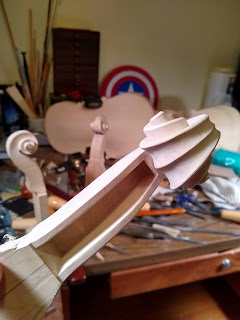
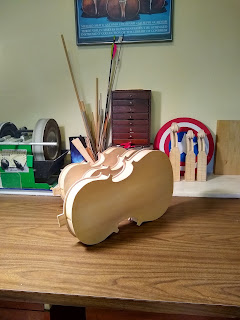
(Messy desk, clean desk.... the cycle of it is fun and exciting, a lot like life in general.)


For me, the best thing to come out of the pandemic was the Women In Lutherie group.

The result of the efforts two women in the luthier community (Jeemin Kim and Jennifer Creadick), Women In Lutherie began as a private Facebook group back in February of this year, and has grown into something remarkable and necessary. I believe when I accepted the invitation to join there were only eight other people there. As of this writing, membership has topped 500.

That's astonishing to me. If we had collected 50 women in the field into one place, I would have been impressed. 500? When I consider how many more women doing this work exist who are probably (quite understandably) nowhere near Facebook, I'm overwhelmed.

I had no idea. And apparently no one else did, either.

Instrument making and repair tends to be an isolating kind of profession. The mentality to do it is rather exacting and introverted. We're happy alone in our space with our tools.

But it's also lovely to be understood. There is pleasure in being able to make remarks about your obscure experience and to have someone else relate without further elaboration. There is a very small subset of people to whom I can say, "The last person glued in the slide" or "The projection is only 15" who will wince along with me. Or who will truly appreciate what it means when I announce, "I finished the corners!" It's a wonderful thing to be able to gather at conventions or workshops and feel like you are with your people.

The Women In Lutherie group takes that one step further, where work experience and life experience converge into something surprisingly meaningful.

Because if you are a minority in a field, your experience is different. Which is why I think it's great that there are now additional groups like the Queer Strings Alliance, and Luthiers of Color. People need spaces where it's safe to be themselves.

There are lots of lutherie groups online. Women In Lutherie is the first one where I feel at home. Which is interesting, because for years I've been under the perception that to identify oneself as a woman luthier was to be associated with a lesser category. One should strive to be the best luthier one can, and gender shouldn't enter into it, right?

Except that "woman" shouldn't automatically be a negative qualifier, which is the impression you get when people steer away from it. However, it's a useful identifier in this industry where we are so few and far between. Maybe one day there will be balance, and the additional information will be irrelevant, much in the same way people don't really say, "woman doctor" or "male nurse" anymore.

I'm a luthier. I'm also a woman. I can put "woman" in front of "luthier" and feel fine about both parts of the label. If someone else wants to sneer at it, that's their problem.

And some do sneer. The number of men who blithely dismiss the idea of a Women In Lutherie group is depressingly high. When I invite a woman in one of the other groups over to WIL, inevitably a man will voice his opinion that any group that discriminates against men is wrong, and women simply need to strive for competence, and there is no reason for us to gather separately.

Whatever.

Let me tell you what is different about our group that makes it necessary.

On the darker side (to get that out of the way), women need a safe space to discuss how they have been mistreated by men. That's simply true. There are some bad, harmful, and oblivious men out there in our industry, and when women share that information among one another, it's a means of protection and healing. We can steer others away from places of danger. We can arm each other with words and knowledge to better confront difficult situations in the future. Our individual experiences with inequitable treatment tend to feel like awkward personal traumas, but collectively, we can see patterns. We realize we're not alone. We can begin to find ways to stand up to it.

Has every woman had such problems with discriminatory behavior at work like that? Of course not. But we all know someone who has, and that's enough for it to be a concern for all. Specific incidents of unequal treatment based on my sex or gender in my work life are minor at best. But I still can't walk alone at night without fear. The way I navigate the world is by necessity simply different from that of my male counterparts, whether they think that is relevant or not.

On the neutral side, some things are just different for women. For instance, until we started discussions online about the tools we prefer, I don't think many of us realized we were trying to adapt to tools not designed for us.

When I was in school, I was one of two female students. Our male teacher wanted us to have the same basic block plane he used. Which makes sense. Good teachers recommend what works for them because they want their students to succeed. But when I got my first nice plane, it was a low angle version. My fellow student did the same. We were just attracted to them and didn't know why. Same when we started purchasing smaller boat-shaped planes. Our teacher was perplexed, and kept saying, "Why do you keep getting these planes?" Until the WIL discussion, it never occurred to me that it was because they fit our smaller hands better. I know why our teacher wanted us to have the high angle planes, but in his hands they felt different. I also had an epiphany about the cabinet scraper he wanted me to use in school. He made using it to scrape ribs look easy. I thought something was wrong with me that I found it so difficult. I thought it was a failing when I left school that I started using a smaller more flexible version. After hearing from dozens of women that they did the same, I don't feel bad anymore. WIL has since begun a list of tools for smaller bodies, that also just includes tools we love, and it's a great resource. 

Childbearing and childcare concerns are also overwhelming female-centric issues. No one ever asks a man when he's about to add children to his family how he will raise them and also work. This is a huge and important topic, and to have other women to discuss this with is sanity saving.

And on the lighter side, the way women discuss things in the group is simply kinder and more productive.

The first week I was in WIL I wasn't sure what I would post there that would be different from any of the other luthier groups I was a part of. But then I had a bad morning and decided to say that I'd just spent ten minutes crying at my bench but was pulling myself back together to get some work done. I never would have admitted that in a normal violin group. What would be the point? But all these women piped up to say they totally got it, and they had also had a good cry at their benches recently, and they had my back, and it was going to be okay. I don't know if I can describe how much better that made me feel.

There are regular Zoom meet ups on weekends where we discuss mental and physical health, safety, tools, techniques... And the rules include things like not apologizing or minimizing ourselves. Women are socialized to not take up space or attract attention for our accomplishments. We are taught to apologize just for being who we are. "I'm sorry" is not allowed and it's liberating. I think many of us have felt empowered to start erasing those tendencies from our speech outside the group.

And then I started noticing the way the women addressed questions about our work.

This group has some of the very best builders and restorers in the entire world. You want to see mind blowing work? Iris Carr can move f-holes. I still don't know why anyone would do this, but she does it in a way that I can't even wrap my brain around. You want to know who other makers use for restoration work? Check out Stacey Styles. You want to meet my building idol? Marilyn Wallin rocks. The list of talent and credentials on the Women In Lutherie page is very long.

And yet the group also welcomes beginners, amateurs, and anyone who wants to be a part of this field. All are included and treated with respect and care.

How is that significant?

Well, on a typical lutherie site, the emphasis is more about being right than anything else. It's exhausting.

Men are probably socialized to be right the same way women are socialized to apologize, and everyone needs to get past these things. But in the meantime, discussions among groups of mostly men about lutherie work is not particularly welcoming.

I know many many perfectly reasonable and charming men in my field. Men who are kind and knowledgeable and would find it uncouth and embarrassing to treat people badly online or anywhere else. In online discussions I skim until I find their names to specifically read their contributions, and I value their input. None of these men are the ones who question the need for a Women In Lutherie group.

The ones who do, however.... Well, they are more vocal than their more civil counterparts.

Language interests me. And how people phrase things in the different groups says a lot.

In a typical lutherie group, if someone poses a question or shares something, there is often a lot of posturing. People tell you there is one way to do something. Anything that deviates is wrong. They are happy to tell you straight up if they think you are wrong.

Also, it doesn't matter how specific you are in tailoring your question, you will get instructions you didn't ask for. My favorite example of this was when a friend of mine simply wanted to know what colors people had on their retouch boards. That's it. She made it clear that she was not looking for advice about doing retouch work, because she was fine there, but she was curious about the names of the pigments other people had as their day-to-day kit. That did not stop a number of men from telling her at length how to do retouch work.

They can be so quick to want to tell you how to do things, they speak up before they even know the real question. I was in a thread the other day where a man went on at length about how my suggestions to someone about gluing a seam were wrong. After reading his own explanation carefully, I realized he'd misunderstood the original question, and was describing what to do with a crack, which is a different thing entirely. (What I was suggesting would be bad for a crack, but maybe make sure you understand the context before slapping someone down?)

You know how people answer questions on the WIL page?

We tend to say, "I do this." We don't tell other people what to do. We describe what we do, and why.

Then we get to compare how other people do things, ask questions, and learn something new.

There are so many interesting ideas out there! I have learned so much! There is not one way to do this work, and when you shut down a real discussion, you lose out on so much experience and knowledge beyond your own. I eat it up, frankly, the myriad of suggestions and approaches that people from everywhere have to offer.

The best was when I went on the page to ask for either help or sympathy for while I was working with a soundpost inside a very tiny violin. None of my standard tools were helpful with something that size, and that kind of job usually took more than an hour. (To be fair, a chunk of that time included swearing and getting up to walk around the shop repeatedly so as not to go crazy.) Most of the women agreed it was a frustrating job to do. But a few had helpful tips, including a luthier in Spain who showed me a picture of a pin she uses to get a soundpost out of a tiny f-hole. Another in Oklahoma had modified a safety pin into a mini-soundpost setter. What a simple and practical solution! Now that job which I used to set aside an hour to do takes me a matter of minutes. If that's the only thing WIL ever gives me, it was enough.

Nobody bickers or nitpicks or lectures anyone. They simply state what they do, and you can take it or leave it without judgement. If someone is new to a repair or a technique, people will walk them through it, offer help through private messaging, or share links to other resources. No one is ever mean or dismissive. And it's definitely the place to go if you are having a bad day and need people to commiserate.

The closest thing I can think of to an argument on the WIL page so far was a polarized thread about geared pegs. The word "abomination" was used. Did anyone take it personally? No. The thing overall was really amusing. And there was even the (impossible to witness anywhere else on Facebook) occasional person saying, "Well that's an interesting take I hadn't thought of. I will reconsider my opinion."

WIL is the first place I ask industry questions now. I know I will get thoughtful answers, and the best possible advice. Occasionally I still pipe up in other groups, but I'm taken aback by the bluntness that does less to be direct than it does to sound authoritative. I'm over that.

In the early weeks of the group, someone posted a violin bridge they'd carved and asked for a critique. For those not in this field, this was a real act of courage. People get really judgemental about how others carve their bridges, and it puts you in a vulnerable place to simply put one out there. I thought the bridge in question was lovely, and I said so. Others did as well. Then the poster insisted we were being too nice and she wanted a real critique. She was bracing for something brutal.

But the thing is, beyond a certain level of detail that is a necessary part of function, bridge carving is subjective. It's a place where, within narrow parameters, you can use some artistic flair. Her bridge was attractive, balanced, and fine. To pretend my interpretation of those curves and lines was "right" thereby making hers in need of a brutal critique, is wrong in my opinion. That was an interesting discussion, and I think helped several of us reexamine the point of such critiques.

The main thing to come out of that post was that more of us have been empowered to show our work to each other with less fear. We also found it moving to see other bridges stamped with women's names.

This rethinking of how to hold our work to high standards while not using a competitive model to measure what we do is useful. It also feeds into what we've come to realize is a different concept of what success is for women. I've thought for years about how the way I run my small business might not meet the standard of what many consider successful, in that our model is not based around growth. I want my business to be sustainable, and enable me to support my family and contribute good things to my community. Success for me means a life that includes many things in some kind of harmony, rather than a few specific areas of trying to be "the best" by someone else's metric. It's reassuring to be in a group that supports that idea.

Other traditional ways of viewing life as a luthier are also being shifted to fit better how women interact and learn. Jeemin Kim was the architect of the Women In Lutherie Fellowship program earlier this year. She matched women at the tops of their specialties with women who wanted to learn from them. But unlike other mentorship programs, this one involved group discussions and an exchange of information that made it more of a collaboration, and less of a hierarchical setup. It was lovely to hear how much everyone involved got from the program, and I know great things will come from it in the future.

Women In Lutherie had it's first conference last month. Three days of really excellent talks and demonstrations. I got to lead one on the last day with the amazing Laura Wallace about pregnancy and parenting in lutherie. Since Women In Lutherie is international, it was fascinating to discover how being in different parts of the world impacted women's choices and options about doing this work while starting a family. (The United States comes out very badly on this score. People in places like Canada listened in disbelief at how little support new parents are offered here.) It's the kind of talk that I think men could benefit from as well, but would be hard to convince them to attend at a mainstream convention.

The rate at which the Women In Lutherie Instagram account alone has grown is incredible. There are currently over 3400 followers of @womeninlutherie on Instagram. I know that's not up there with makeup influencers, but for a group about women who build stringed instruments? That's way more than I ever would have believed would want to follow such a niche group. (But it's good! Check it out!)

So there has been lots to despair about during the pandemic. It's been sad, and lonely, and heartbreaking. But out of it, there was time to create something many of us didn't know we needed so badly. It's long been my hope to raise the profile of women in our industry enough that girls see it as an option open to them, and not an oddity. I love my job. I think there are many other women who would love it too.

I love Women In Lutherie. It's come a long way in a matter of months. I cannot wait to see where we go from such promising beginnings.

Monday, October 25, 2021

Grand

I have the privilege of playing with a wonderful group of musicians here in Milwaukee in an orchestra called Festival City Symphony. Once upon a time they were the Milwaukee Civic Orchestra, but they changed the name to Festival City (which reflects the exciting number of festivals Milwaukee hosts annually) a couple of years before I moved here.

It's an orchestra comprised of people who take music seriously, and probably majored in it, but performance did not become their day job. There are a lot of music teachers and gig musicians and freelancers, but many who do any number of other jobs to pay the bills and still make the time for orchestra. Because if you grew up playing in an orchestra, it's hard to picture life without it.

Many musicians got a taste of life without it during the first year of the pandemic and it felt like missing a limb. Festival City canceled the end of its season in the spring of 2020, but started up again with many protocols in place in the fall. I ventured back into rehearsals and onto the stage earlier this year. It's been a relief and a challenge all at once.

The opening of this season, however, was remarkable. We are in a new exciting space.


Our concerts pre-pandemic were in the Pabst Theater. It's beautiful, and has my favorite chandelier. During the pandemic we shifted to a hall out at the Wilson Center, which was fine. (A bit of a haul out of the city, but fine.) However, for several years the Milwaukee Symphony Orchestra has been renovating an Art Deco movie theater in the heart of downtown called the Grand Warner. It has sat closed the entire time I've lived here, and I only heard stories from people about how beautiful it was inside. The MSO acquired the building and put a lot of effort and money into moving walls to create a real stage, and expanding the building with a modern addition to the side. The grand opening was supposed to be fall of 2020. They only just moved in recently.

One of the benefactors who donated money to the whole enterprise happens to be a former Festival City musician. He loves our orchestra and knows its worth to the community. He managed to carve out a deal that allows us to perform in that gorgeous building as well.

Wow.

Now, I'm a bit sad that the last time I performed in the Pabst, I didn't know it was the last time I was performing on that stage. The plan was always to move on to the new Bradley Symphony Center inside the Warner theater for this season, but with the previous season cut short and then the venue moved, we didn't finish at the Pabst the way we expected to.

However, what an incredible experience to play in a hall that is specifically designed for an orchestra. Not a space that is designed for a variety of events that an orchestra can also use. This new hall is conceived entirely around what a symphony orchestra needs and you feel it at every turn.

First of all, just from an anyone perspective, the whole building is stunningly beautiful. In centuries past, the grandest structures that money could buy in any town were usually places of worship. In modern and more secular times it seems to me that museums and concert halls are the new cathedrals where society places the greatest importance on design and beauty in order to cradle and showcase the achievements of which we are most proud. This new hall is no exception, and is one of those landmarks where you feel a tad smug that people outside of Milwaukee don't know what they're missing. The great things in our city don't tend to be for tourists, since nobody visits Milwaukee without a reason. There's something extra special about stepping inside a beautiful concert hall that is intended for us, the locals. I hope everyone in the city gets a chance to enjoy it and feel inspired there.

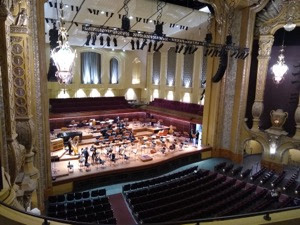
This is the point where I'm going to apologize for not having better pictures. (Go look at the pretty ones in that first link when you have time.) Most of what I had access to was from the stage or behind the scenes, and when I went out in the general areas to explore, I kept hearing staff on their modern walkie-talkies behind me sharing the information that, "The musicians are wandering." I was eventually gently herded backstage, but not before I poked my head onto the balcony to see what things looked like from that direction.

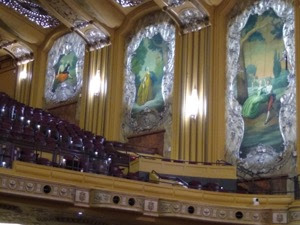
There are restored paintings on the walls of very white people doing very stylized rich people things which are both pretty and kind of funny.

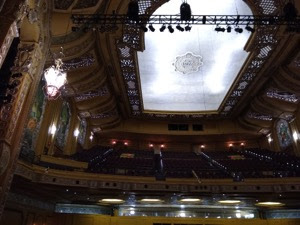
I miss the chandelier from the Pabst, but it makes sense that in a theater originally designed for movies one wouldn't have made a lot of sense. But there is a lovely ceiling nonetheless, and a couple of elaborate light fixtures hanging off to the sides.

And I only got a glimpse of the lobby from above, but it was all just gorgeous.

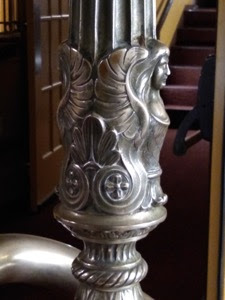
And everywhere you look there are restored details to admire (like this one little piece of a bit of railing at the top of the stairs).

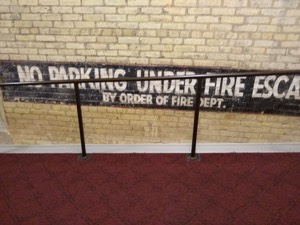
One of the other details I enjoyed was where they left evidence of the original outside walls. I noticed in the alley I walked through next to the building when I was trying to find the stage door, that there were old painted warnings on the brick admonishing people not to park below the fire escapes (which was amusing since there are no fire escapes on any of those walls now). Some of those same warnings are now inside the building! I love that they left that when they expanded beyond those walls.

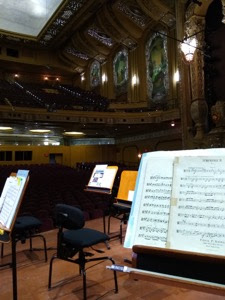
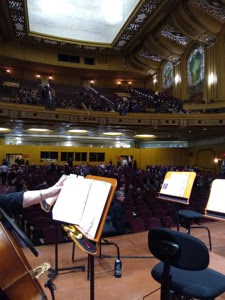
So that's the kind of stuff everyone can get to enjoy. My perspective is generally more like this:


But here is a good place to start pointing out cool musician oriented details! First of all, the stage chairs are fancy. I don't know if they are smart, because we had to get a tutorial at the beginning of the rehearsal mostly to inform us that the two levers under the seat must only be ever pulled up. Apparently if you push down on them (and everything about them suggests you should push down on them) they will break. One lever adjusts the height of the seat, and the other the angle, but I was too scared to touch them and decided I was fine with whatever height and angle was there when I sat down. But they were very comfortable and excellent for orchestral playing,

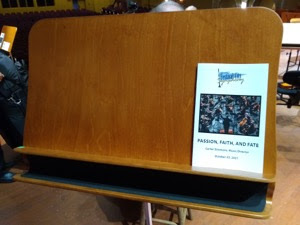
The other thing is the stands. I wasn't sold on the chairs, but I want one of those stands.

It was solid, wide, and smooth (the most common type of stand has inexplicable bumps on it that sometimes interfere with marking a paper part with a pencil), and best of all had a lower shelf lined with a grippy material perfect for setting your bow in. (And considering there's an entire movement of the Tchaikovsky symphony we played that's all pizzicato, that shelf came in handy.)

That shelf is also perfect for pencils, rosin.... I love the shelf.

Only less than optimal thing was the height adjustment required you unscrew something first, but eh. You don't do it that often anyway.

The brass and woodwinds had their own sections on risers. And there are seats behind and on the sides above the orchestra that I assume are for singers.

But it's the stuff offstage that I think I appreciated most.

At the Pabst, the green room was under the stage. It was okay. There were some tables and chairs, a couch or two, inadequate bathroom facilities, a TV that was only on when players wanted to check a Packer game. There were dressing room spaces that some people used to unpack their instruments and store their cases and coats, but most of us found space to balance our things on random beams that were the structural supports behind the adjustable stage walls. There were a few tables on one end, and cellists tended to prop their cases along a wall, but not too close to the hot pipes. It was dark back there, and dirty. It wasn't really where we were supposed to store our things, but it was the most convenient place in terms of proximity to the stage.

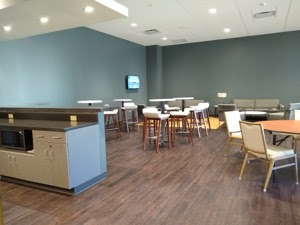
The new building? Well, the green room is across the hall and on the same level and includes monitors of the stage.

Lots of light in this building, and lots of windows. And I noticed signs indicating practice rooms upstairs, so that must be nice. 

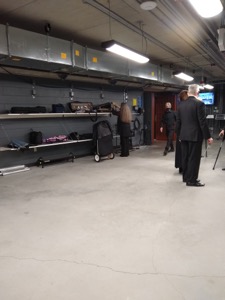
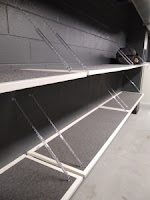
And in the wings around and behind the stage there was so much light and useful storage! Not to mention several mirrors, a couple of large monitors so you could see the stage, and lots of room to move.

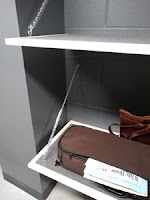
Even the chains on the shelves had little plastic covers on them so you wouldn't snag yourself on anything. It was great to have an actual spot to set my case right off the stage.


There were cubbies for cellos on their side of the stage.

Also? Amazing security. That place was on top of everything (including "wandering musicians"), so I wasn't worried about leaving any of my stuff backstage. 

This concert was also the first event I've attended since the pandemic began that required proof of vaccination (or two negative tests within a few days), and nearly everyone was masked, so I was far more at ease in such a crowded setting than at anything similar in recent memory.

And aside from all the beauty and practical details? The hall sounds incredible. Which is truly the whole point. The sound engineers and acoustics people did an astonishing job. It's almost a little too good, in that you can hear everything on that stage and you become very self aware. I took my necklace off after the sound check, because the clicking sound it made as I put my instrument to my neck seemed like it might carry to the audience. Probably not? But it sure felt possible.

I'm pleased to report the concert itself went well. We played Dvorak's Carnival Overture, Bizet's Orchestral Suite from Carmen, and Tchaikovsky's Symphony Number 4. And I have to say, the sound of the brass reverberating in the hall in the rests following their big opening chords of the symphony was really something. It is a magical place to hear the power of live music.

If you're in the area and want to experience something grand, I highly recommend you get a ticket to whatever is happening there. (And Festival City Symphony concerts are free! Come join us! This season's schedule is here. William Grant Still, Aaron Copeland, Mendelssohn, Schubert... lots to like.)


Sunday, September 5, 2021

Was it enough?

We dropped our daughter off at college last week.

We got her set up in her dorm room. Very easy move in. She has what we're calling her "limbless couch" under her lofted bed, where I expect she'll spend a lot of her recharging time. (The couch is armless, and also sits directly on the floor, so, no limbs.) We took her to an early dinner. We walked around some of the campus and a bit of the main street in town. We met her charming roommate from Pakistan. And then we left her there at North Hall.

I didn't cry until that last hug. Aden said something about it feeling strange that we were leaving her and she wasn't going home with us. I told her I've spent her whole life trying to not leave her behind anywhere, so it was odd for me, too. She stood on the sidewalk and watched us walk away. And I burst into tears.

Her first night in the dorm was Thursday. She's now spent three nights away from us. She's fine. It's all fine. But the closest thing this feels like to me is when we moved her as a baby into her own room to start sleeping through the night. We kept our babies in a co-sleeper attached to our bed when we brought each of them home. It was a safe space for a baby to sleep where I could still scoop them up easily when needed. I liked having them right there essentially in my bed where I could watch them breathe. But then at four months when Aden didn't need to eat in the night anymore, and was sleeping seven hours or more at a stretch, we moved her to her own crib and I cried. It felt stupid to cry. But I missed her.

I miss her now, too. And just like when she was a baby, and I could count easily on one hand how many nights she'd spent in her own room, it's hard. In a few weeks, I won't be able to recall exactly how many nights she's been away. But today that number is three and I feel it acutely.

Technology is easing things, though. When Aden was originally preparing to leave for school in 2020 (before the world shut down and she deferred college), I asked what the easiest way to stay in touch with her would be. I'm not a person who texts or video chats, but I would do those things if that meant keeping in touch with Aden. She told me she prefers Discord. So I joined Discord as "Aden's Mom" since she was the only person I planned to talk to there. But then things got extended into various family chats, and it looks like I have confessed to a favorite child because I am "Aden's Mom" in all of them until I can figure out how to change it.

Through Discord I've gotten to see Aden's new art supplies and admire her new textbooks. (UW Stout is smart about everything, so the art supplies are bundled into affordable kits at a local store, and all the books are rented and collected from the library.) She got help from her dad for her roommate's phone problems. Last night we gathered as a family online to play a couple rounds of Jack Box, and it was fun to hear her laugh and interact with her siblings like normal. We were even able to watch another episode of Star Trek together by streaming Netflix over Discord, and we commented as usual about Klingons and Vulcans during the show. Aden was watching from her bed with headphones on, and I could hear her roommate chatting once in a while with someone on the other side of the room.

It's comforting, because she's away, but she can still participate in regular family stuff here and there. I suspect once classes start we'll hear less from her, but for now? While those nights away I can still count on one hand? I like that she's as close as my phone.

I can't imagine anyone is surprised by the idea that I miss my daughter. But the main thing I'm pondering as she ostensibly begins life on her own as an adult is did I do enough to prepare her? And was her childhood okay?

Because it sort of hit me all at once that her childhood is over. Officially and forever done, so whatever I meant to do by now as part of that, I've missed my chance.

We did lots of good things, but was it enough? There were books I didn't read her, and movies we didn't see. Did I take her enough places? Add enough special touches here and there? Should I have made her practice more? I'm feeling guilty about any time that I yelled and I shouldn't have. We got her a dog, but he was so weird. I think I should have taken her roller skating more often. I feel like there were crafts we were supposed to do together, or wisdom I should have imparted.

Was it a good childhood? Because it was up to me to make it so, and I hope I did okay.

And is she ready to be an adult? In many ways, more than I was when I left for college. But in others, maybe not?

She still doesn't have a driver's license. She does know how to vote. Cooking we've got covered, because at this point she's a better and more adventurous cook than I am. She can swim, so at least I made sure that happened. She doesn't use the phone well and she's bad at making appointments, so maybe I should have done more there? How? 

My mother once told me that she never wanted keep us as little kids because she loved interacting with me and my brothers as adults, but that it would be nice to go visit us as small children again. Isn't that a lovely idea? I think about it a lot. But I also think it would completely tear my heart apart to go back and see Aden as the chatty three-year-old she used to be, or the clever eleven-year-old, or the mysteriously empathetic baby she was in my arms.

I still remember that baby in my body, kicking me at orchestra rehearsals every time the music stopped. Eighteen years seems like a long time to get to show things to a person. How did I miss so much? How can it be done already? I cannot believe my first baby is in college.

I miss her. I'm excited for her. I hope she's doing okay. I hope I gave her enough.


Thursday, August 19, 2021

The Dwindling of the School Firsts and Lasts

I'm one of those moms who always insists on a first day of school picture. I don't ask for much, so my kids always indulge me. Doesn't mean they look happy in those pictures, but those regular markers in time do capture a lot of growth and change.

Looking back on all that growth and change, I am astonished at how fast it has gone. Especially when so many days seemed to crawl by, seeing that the years have flown takes my breath away sometimes. The markers matter, because various milestones of firsts and lasts force us to stop and notice before it all slips away.

This year and the previous one have been such a peculiar blur that the firsts and lasts have gotten all out of whack, particularly where school is concerned.

My oldest daughter didn't get to finish high school in a way that felt anything like closure. School simply stopped last March. Everyone expected to be gone for a couple of weeks, then return to class. That never happened. Aden got to venture back into the abandoned school at an assigned time to retrieve her projects from the art room eventually, but that was it. There was an unsatisfying "graduation" ceremony that was just an online video. She got a cap and gown but no event at which to wear them.

Aden indulged me in my mom-photo moment, where I had her put on the cap and gown and pose outside of our house. It was more like dress-up than anything else. It reminded me of how I wasn't a girl who ever dreamed of wearing a wedding dress, and always assumed if the time came I'd just wear something practical that I could wear again. But when it was time to actually plan my wedding, it hit me that only on that one day could I wear a dress like that where it wouldn't be play-acting or strange. I could walk around in that dress exactly once without having to explain myself. I decided not to blow that chance. A cap and gown is like that. It's a costume with an expiration date. And in Aden's case, the date got erased.

Aden's first day of college became unmoored as well. Covid robbed us college tours, but Aden was accepted to all the art schools she applied to. When she decided on UW Stout, she went through the procedures of registering for classes and getting a dorm room assignment, etc. But then the pandemic numbers became too scary and she deferred for a semester. She repeated the whole thing for the spring semester, and deferred again.

By the time she registered for everything for this fall, she felt quite competent at navigating it all this time around after so much practice. We've gotten the campus tour finally. She's been in contact with her roommate. We've bought the Twin XL sheets, and I own a UW Stout blanket I can snuggle in the TV room when I can't snuggle my daughter this fall during Star Trek. That first day of school was delayed, but is finally happening. Although I won't get to take an actual first day of school picture this time. The last one of those for Aden was in fall 2019. After so many years, that tradition is over.

At a different end of the high school spectrum is Quinn. He had his eighth grade completion ceremony this spring. Which means after three kids, and fifteen years, we no longer have anyone at Fernwood Montessori. That is a shift in our lives that is hard to grasp.

And again, the transition in these pandemic days is hazy. Fernwood normally has a tradition of the seventh grade parents throwing a dinner event for the graduating eighth grade families, and the kids get certificates, and everyone gets to say goodbye to teachers they've known for so long. But Quinn did the last few months of seventh grade online, stayed online for nearly all of eighth grade, and only went back to in-person school for the last few weeks of the adolescent program. As parents, I'm not sure when we last stepped foot in the building. Quinn's seventh grade class didn't have a part in the Winter Concert, and Covid shut life down before the annual science fair, etc. I think the fall parent/teacher conference in 2019 was the last time I was inside Fernwood. And now we're done there, and there is no reason to step inside again. It's surreal. The number of hours I spent doing volunteer work, meeting with teachers, attending cultural fairs and Halloween dances.... There was no official conclusion to any of that. It just faded away as if it had no meaning.

I will take a moment here to say something about all that time at Fernwood Montessori. Like everything, it had its ups and downs, but for the most part I'm glad my kids got to go there. My kids have complaints that they weren't allowed to play with sticks on the playground, and fellow parents understand that the Montessori philosophy--although good on paper--doesn't mean our kids can figure out to put on a coat when it's cold out, but overall it was an environment that held up kindness as a guiding principle. I remember being concerned about the behavior of a violin teacher that was brought into the school for lessons, and Aden agreed to peek in on the class to spy for me. She told me the teacher was yelling at the kids. Her assessment was, "It was not Montessori." I liked that in my daughter's mind, Montessori was equated with being kind above all. (And yes, I did my best to do something about the bad violin teacher, but eventually budget cuts did it for me.)

Despite whatever my kids want to say about Fernwood simply because it was "school," I know they were cared for there, and guided in ways my peers and I were not when we were growing up in our own schools. One of our few regrets is that Aden never received proper credit for her design that was turned into a mosaic on the addition to the school building a few years ago. She was thoughtful about it, drawing on elements of the "Cosmic Opera" that her lower elementary teacher put on annually for many years. Many kids submitted designs, and she was surprised when hers appeared on the building without any acknowledgement. There's no way to prove it at this point, but I'll share it here, so there is a record somewhere in the world that Aden came up with this concept to represent her school:


Fernwood did have a ceremony for Quinn and his class, but it didn't feel connected to anything we knew. They held it in a neighboring high school that had room for distancing. Each child was limited to two guests. Everyone was masked and far apart. The kids were separated from the audience. A few kids spoke. The principal and a teacher spoke. There was no mingling. There was no dinner. There were no goodbyes. The one part of the eighth grade graduation that I've always loved is the slideshow of the kids set to music. Everyone submits photos of their kids as babies, and as younger kids, and finally present day, and it's really moving to see all those little faces grow up on a big screen. I submitted my three photos of Quinn that I wanted to see up on that screen, but due to some sort of deadline technical glitch, when Quinn's name came up, it was only accompanied by a goofy stick figure. Thus ended our time with Fernwood.

I did get a first day of school photo of Quinn standing outside his bedroom door about to start virtual classes for eighth grade. It is a noticeable break in the pattern, but then so was all of 2020.

This week he started high school. That first day of school picture is back to Quinn standing on our front porch in his jacket, looking uncomfortable and sweet, doing what his mom asks of him even if he'd rather stay out of view. He's attending in-person, but it's hard to say for how long based on how many Covid cases were reported on the very first day of class. He has a fresh supply of masks, which is the strangest addition to our back-to-school shopping list, that sadly no longer feels that strange.

Our middle child is in the most nebulous set of school firsts and lasts. Due to health concerns, she didn't attend her eighth grade graduation from Fernwood back when that happened. Then she did a year of high school, most of a second year of high school before the pandemic shut things down, and all of her junior year was virtual. I managed to eke out a VERY reluctant first day of school-in-the-house picture for that one.

Compared to all the time we spent at Fernwood, I feel sadly disconnected from Mona's school. Which is a shame, because Bay View High School is where my grandfather went. It's a beautiful building with excellent teachers. It's right on the park and only a few blocks from our home. I've wanted to be a part of things there. But my daughter wants distance from her parents in a way her older sister didn't, and the kinds of activities that interest her never invited us into the school. When we sat in the auditorium for Quinn's eighth grade graduation, it occurred to me that we'd never had occasion to be there for anything related to my child who actually attends that school. We've never seen a play or a concert or a science fair or a sports event. I've only stepped inside the school for conferences or a medical issue.

She's now in her senior year, back to in-person. But she managed to get ahead in credits by doing summer school every year, and only needs a couple of English classes to graduate, so she should be done with high school before 2021 is up. Are there "graduations" for people who finish school midway through the year? Does she get a cap and gown? I doubt it. Especially in Covid-times where ceremonies don't really happen to begin with. She's also only doing half days, and showing up at lunchtime at the violin store where we've hired her to work. Since I don't see her leave in the morning and she arrives only a couple of hours after I get to the store, it barely feels like she's in school at all. So she may finish high school with the least fanfare yet.

It's really messing with me. I didn't realize how much I relied on certain milestones to keep my parenting identity anchored. I never cared about graduation ceremonies until they all went away. Maybe I'll get to see Quinn march one day? As we listen to boring speeches on a hot spring afternoon? I sincerely hope so.

Because I only have so many firsts and lasts left to document. There are only three first day of school photos left to take of Quinn. Once those are done, I'm left to the mercy of whatever my kids choose to share as they move entirely into worlds of their own. I hope they remember to take a picture once in a while. I want to see them.